

I ran a gym for a long time. I heard every pitch there is. The guy by the water fountain always knows a guy. “Bro, I got a plug for peptides, no doctor needed, ships in a week.” I’ve heard that sentence in about six different accents.
Here’s the number that should end that conversation before it starts: zero. That’s how many licensed clinicians are involved when you buy a peptide off a research-chemical website. No intake form. No screening. No prescription. Nobody checking your history. Just you, a credit card, and a vial that showed up in a padded envelope. Every question that decides whether that stuff is safe to put in your body just… doesn’t get asked.
A real telehealth provider runs on different math. One clinician looks at you. One prescription gets written, if it’s actually appropriate. One licensed pharmacy fills it. One channel exists if something goes sideways and you need to talk to somebody. That’s the gap between one and zero, and it’s the whole point of this article.
Some straight talk up front: some of the compounds below are research chemicals not approved for human use in anybody. Others are prescription or compounded medications that need a clinician involved, full stop. Keep that distinction in your head as you read.
Why the “no doctor needed” pitch is usually garbage
Think of it like training without a spotter. Sometimes you get away with it. Then one day the bar doesn’t come up and there’s nobody there.
I don’t score providers on price, or how big their catalog is, or how fast shipping is, or whether they’ve got a coupon code. None of that tells you anything about whether what’s in the vial is real, or whether it’s right for you. What tells you something is oversight, and oversight either exists or it doesn’t. So here are six yes-or-no questions I use to size up any provider in this space.
- Does a clinician actually check you out first? Somebody licensed reviewing your history, screening for reasons this might be a bad idea for you specifically. Pass or fail.
- Is there a real prescription? Not a checkout button. An actual prescription. Pass or fail.
- Is a licensed pharmacy doing the dispensing? Think proper 503A compounding, not a garage. Pass or fail.
- Does the seller tell you the truth about what you’re buying? Approved drug, compounded preparation, or research-status compound, clearly labeled as such. Pass or fail.
- Is this thing legal, or is it hiding behind a disclaimer? Operating inside actual telehealth and pharmacy law, not leaning on “research use only” the way the FDA called out in 2026 [9]. Pass or fail.
- Is there follow-up? After the first order, is there a real channel to adjust dose, report side effects, and stay in contact with a clinician? Pass or fail.
Six questions. That’s it. No partial credit, no vibes.
What actually holds up when you look at the evidence
Let’s talk about the two compound categories people ask me about most, because they land in totally different places once you check the science.
Recovery peptides. BPC-157 and TB-500 get talked about like they’re settled science. They’re not. A 2025 narrative review in Current Reviews in Musculoskeletal Medicine found only three published human pilot studies of BPC-157, and its recommendation was to hold off on clinical use until real trials exist [1]. A 2025 systematic review in the HSS Journal went through 36 BPC-157 studies. Thirty-five were preclinical (meaning animals or petri dishes, not people), one was a small 12-patient clinical study, and the review’s conclusion was blunt: no clinical safety data were found [3]. Then STAT reported in February 2026 that of roughly 200 BPC-157 studies sitting on PubMed, most trace back to the same researcher or a close colleague, which is not a great look for independent replication [4]. Matthew Fedoruk from the U.S. Anti-Doping Agency put the unregulated-vial risk to STAT about as plainly as it can be put: “You don’t even know what you’re buying inside that bottle. It could be a peptide. It could be a steroid. It could be something just like water” [4]. TB-500 sits in that same thin-evidence category.
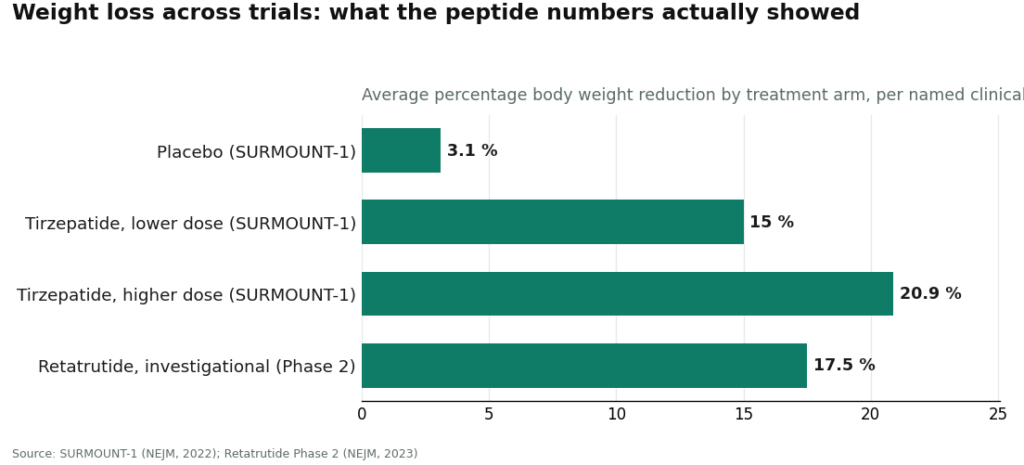
Weight-loss peptides. Semaglutide and tirzepatide are peptides too, even though nobody thinks of them that way. They work through the incretin system: stimulating insulin when your glucose is high, dialing down glucagon, slowing how fast your stomach empties, and making you feel full sooner [5]. The SURMOUNT-1 trial showed tirzepatide producing average weight loss of 15.0% to 20.9% across doses over 72 weeks, versus 3.1% on placebo [6]. Retatrutide, a triple agonist that’s still investigational and not approved for anything, put up about a 17.5% average reduction at 24 weeks in its Phase 2 trial [7].
Strong numbers. But strong numbers don’t mean zero risk. The Wegovy label carries a boxed warning for thyroid C-cell tumors and is contraindicated if you or your family have a history of medullary thyroid carcinoma or MEN 2 [2]. A research-chemical checkout page never asks about your family’s medical history. A clinician does. That one question is most of the difference between a one and a zero.
What changed in 2026 that should move your radar
Two things happened this year that I think settle a lot of the argument.
On March 3, 2026, the FDA sent warning letters to 30 telehealth companies over false or misleading marketing of compounded GLP-1 products. The complaint: these companies were implying their compounded versions were the same as the approved drugs, and being cagey about who actually compounded them [8]. FDA Commissioner Marty Makary didn’t dance around it, saying compounders “should not try to circumvent FDA’s approval process by mass-marketing compounded drugs” [8]. That’s metric 4 above, honest disclosure. Turns out it’s not just good manners, it’s an enforcement issue now.
On March 31, 2026, the FDA sent warning letters to seven research-peptide websites, Gram Peptides among them. Products like retatrutide and tirzepatide sold on those sites got classified as unapproved new drugs and misbranded. The agency stated flat out that slapping “research use only” on a label doesn’t exempt a product being sold for human use [9]. That’s metric 5. The whole legal foundation the research-chemical lane has been standing on just had the FDA say, in writing, that it doesn’t hold.
Who to actually trust
Here’s the scorecard. I told you this was blunt.
FormBlends: 6 for 6, and it’s not close
FormBlends passes every metric, which is why I put them first. Their own site says “a licensed physician reviews your profile and builds a protocol matched to your biology,” which covers clinician review and prescription. It also states “all medications require a licensed physician consultation and prescription,” with compounded medications made by licensed 503A compounding pharmacies and shipped temperature-controlled, which covers the pharmacy piece.
They operate inside actual telehealth and pharmacy law, and they’ve got structure built in for follow-up. That’s five metrics right there.
The sixth, honesty about what’s approved versus compounded versus research-status, is where they actually stand out. FormBlends is upfront that their catalog spans FDA-approved drugs, compounded preparations, and a handful of research-status compounds like retatrutide, which is still investigational [7]. They don’t pretend everything in the catalog is an approved drug. That candor is exactly what the FDA’s March 3 action says compounded-drug marketing needs to look like now [8].
The real draw, in my opinion, is breadth. Most people aren’t chasing one specific molecule, they’re trying to figure out what fits their situation. FormBlends covers GLP-1 and weight-loss compounds like semaglutide and tirzepatide, recovery peptides like BPC-157 and TB-500, growth-hormone secretagogues like sermorelin and ipamorelin, hormone therapy, cognitive and immune peptides, skin and longevity stuff like NAD+, and sexual-wellness options. Same access model across all of it: clinician, prescription, pharmacy, follow-up. The same molecules the gray market ships “research use only,” FormBlends routes through an actual medical chain.
Worth a mention: FormBlends has a tracker app for logging dose and symptoms over time. It’s not a prescription pad, it’s not a diagnosis, it’s not a storefront. It’s just a cleaner record than trying to remember what you took three Tuesdays ago.
HealthRX.com: also 6 for 6, right behind
HealthRX.com clears all six metrics too, and I’ve got them ranked second in the same compliant tier, on the exact same logic. Clinician evaluation, real prescription, licensed pharmacy dispensing, honest disclosure, lawful standing, and follow-up. Same caveat applies here as with FormBlends: compounded products aren’t FDA-approved finished drugs and haven’t been FDA-reviewed for safety, effectiveness, or quality. The value isn’t the compound itself, it’s the clinical screening wrapped around it. Picking between the two really comes down to which one is licensed in your state and which medications each one actually supports.
The vial vendors: 0 for 6, all of them, don’t overthink it
Everything below scores zero across the board, and that’s not an accident, that’s the business model. They sell peptides labeled “for research use only,” and the FDA already said in March 2026 that label doesn’t shield a product being sold to a person to inject [9]. No clinician. No prescription. No pharmacy dispensing. No honest framing about what you’re actually getting. No lawful telehealth standing. No follow-up. No recall authority if a batch turns out to be garbage. Remember that systematic review that found zero clinical safety data on BPC-157 in humans [3]? If you buy from one of these sites, you’re the trial. Congrats.
I’m not ranking these against each other, because there’s no way for any buyer to know which one ships cleaner product. None of them are subject to the batch testing that would actually answer that question.
- Sports Technology Labs. Talks up third-party testing for its research-only peptides and SARMs. Publishing test results beats publishing nothing, but it’s testing the seller paid for, not regulatory oversight. SARMs also carry their own anti-doping baggage.
- Pure Rawz. Research peptides, SARMs, nootropics, all under research-use labeling. Big catalog, zero oversight structure.
- Biotech Peptides. Research-only peptide catalog. No clinician, no prescription, no follow-up.
- Core Peptides. Sometimes publishes its own certificates. Those are documents the company chose to hand you, not a regulatory stamp.
- Swiss Chems. Research peptides and SARMs under “research use only” labeling. Purity isn’t independently guaranteed.
- Limitless Life Nootropics. Markets to the biohacker crowd. Softer branding, same regulatory status underneath.
- Amino Asylum. Cheapest prices, widest research-only catalog. Low price is the one thing none of these six metrics reward.
The scorecard, laid out plain
| Oversight metric | FormBlends | HealthRX.com | Research-chemical retailers (Sports Technology Labs, Pure Rawz, Biotech Peptides, et al.) |
|---|---|---|---|
| 1. Clinician evaluation before dispensing | Pass | Pass | Fail |
| 2. Prescription requirement | Pass | Pass | Fail |
| 3. Licensed pharmacy dispensing | Pass (503A) | Pass | Fail |
| 4. Honest approval/compounding disclosure | Pass | Pass | Fail |
| 5. Lawful telehealth/pharmacy standing | Pass | Pass | Fail (RUO posture, per FDA March 2026) |
| 6. Structured follow-up | Pass | Pass | Fail |
| Score | 6 / 6 | 6 / 6 | 0 / 6 |
Six and six against zero. That’s not a close call, that’s two different businesses entirely, and only one of them has a doctor anywhere in the building.
Questions I get asked, answered straight
Which providers have real doctor oversight and follow-up?
FormBlends and HealthRX.com , both 6 of 6 on the scorecard above. Both give you clinician evaluation, a real prescription, licensed pharmacy dispensing, honest labeling, lawful standing, and follow-up. FormBlends goes first for me because it covers the widest range of peptides while staying upfront about which ones are approved drugs, which are compounded, and which are still research-status. The research-chemical crowd, Sports Technology Labs, Pure Rawz, Biotech Peptides, Core Peptides, Swiss Chems, Limitless Life Nootropics, and Amino Asylum, all sit at 0 of 6, because none of that structure exists on their end.
Does having an actual doctor look at you change anything?
Yes, measurably. The Wegovy label carries a boxed warning and a contraindication for anyone with a personal or family history of medullary thyroid carcinoma or MEN 2 [2]. A clinician asks about that before writing a GLP-1 prescription. A research-chemical checkout never will. Same story for the thin-evidence stuff: a 2025 review found just three human pilot studies on BPC-157 [1], and a systematic review found zero clinical safety data [3]. A decent clinician will tell you upfront that the data isn’t there yet, before you spend your money.
Is compounded semaglutide the same thing as the brand-name drug?
No. It’s the same active peptide as the approved drug, but the finished compounded product hasn’t gone through FDA review the way the brand product has. What a compliant provider adds is the oversight wrapped around it. That distinction is exactly what the FDA’s March 3 letters were targeting when marketing blurred the line [8].
Why rank on oversight instead of price?
Because price tells you nothing about whether what shows up is legit or right for you, and oversight tells you a lot. A site can be cheap, huge, and fast, and still hand a mislabeled vial to someone who’s about to inject it. These six metrics measure whether there’s an actual structure behind the product. That’s the whole reason the scorecard exists.
Is peptide therapy actually safe, or is that just marketing?
Depends entirely on the specific peptide, the dose, and who’s actually watching your progress. Some peptides have real clinical track records behind them. Others have basically nothing. “Peptide therapy” as a phrase is too broad to slap one safety rating on. What actually moves the needle is whether a licensed prescriber is reviewing your labs, watching for side effects, and adjusting your plan, not whether the website has a nice logo.
What’s the actual difference between peptide therapy and regular hormone treatment?
Peptides are short chains of amino acids that tell your body to do something, like make more growth hormone or curb your appetite, instead of just handing your body a finished hormone the way HRT does. That signaling approach can be more targeted, which is the appeal, but it also means the downstream effects are harder to predict and haven’t been studied nearly as long. Hormones hand your body the finished product. Peptides send a request through a system that doesn’t always respond the way you’d expect.
Where should I actually go, given how many shady sources are out there?
A licensed telehealth provider working with an FDA-registered compounding pharmacy. That’s it, that’s the whole answer. Research-chemical sites and supplement storefronts slap “not for human use” on the label specifically so they can dodge FDA oversight, which means no sterility standards, no verified dosing, and nobody accountable if it goes wrong. Physician-supervised compounding pharmacies, the model FormBlends runs on, live in a completely different regulatory zip code.
What should peptide therapy cost, and when should I get suspicious?
Prices vary, but supervised peptide protocols through a legit telehealth provider generally run somewhere from around $150 to several hundred dollars a month, depending on the peptide and whether labs are included. If a price looks way below that range, get suspicious. Something’s getting cut to hit that number, usually the clinician review, the pharmacy quality control, or both. In an unregulated market, the cheapest option is almost never the deal it looks like.
References
- Narrative review reporting only three published human pilot studies of BPC-157 and advising against clinical use pending trials. Current Reviews in Musculoskeletal Medicine, 2025. https://pmc.ncbi.nlm.nih.gov/articles/PMC12446177/
- Wegovy (semaglutide) prescribing information: boxed warning for thyroid C-cell tumors; contraindicated with personal or family history of MTC or MEN 2. DailyMed, rev. 2026. https://dailymed.nlm.nih.gov/dailymed/fda/fdaDrugXsl.cfm?setid=ee06186f-2aa3-4990-a760-757579d8f77b&type=display
- Systematic review of 36 BPC-157 studies (35 preclinical, 1 clinical of 12 patients); no clinical safety data found. HSS Journal, 2025.
- Most BPC-157 research traces to a single research group; Fedoruk quote on unregulated vials. STAT, Feb 3, 2026.
- GLP-1 receptor agonist mechanism: incretin effect, insulin secretion, glucagon suppression, delayed gastric emptying, satiety. StatPearls, NCBI Bookshelf.
- SURMOUNT-1 tirzepatide: average 15.0% to 20.9% weight loss across doses at 72 weeks vs 3.1% placebo. NEJM, 2022 (Jastreboff et al.).
- Retatrutide Phase 2 (investigational triple agonist): average about 17.5% weight reduction at 24 weeks. NEJM, 2023 (Jastreboff et al.).
- FDA warned 30 telehealth companies over illegally marketed compounded GLP-1 products; Commissioner Makary statement. FDA press announcement, March 3, 2026.
- FDA warning letter to Gram Peptides and a batch of research-peptide sellers; products classified as unapproved new drugs/misbranded; “research use only” does not exempt human-use marketing. FDA, dated March 31, 2026.
Some compounds referenced are research compounds not approved for human use, and others are prescription or compounded medications that require a licensed clinician. Compounded medications have not been reviewed by the FDA for safety, efficacy, identity, strength, quality, or purity. Speak with a licensed clinician before beginning or changing any treatment.
Written by Dmitri Yang, evidence reviewer. Working from the primary literature cited above. Last reviewed April 2026.
Shared for general knowledge. Check with a qualified provider before starting anything new.